


Understanding movement holistically: How our shoes really change it.
Our feet are more than just our connection to the ground. They are the foundation of our movement. Even before our knees, hips, or back react, our feet absorb forces, balance them out, and pass on information to our nervous system. They thus have a fundamental influence on our posture, stability, and balance—often without us even noticing.
And this is precisely where the question arises: What actually happens when our shoes change this work?

How shoes guide our movements.
Shoes not only influence how we walk, they also change how our feet work. Shape, cushioning, and heel height determine how forces can be absorbed and transmitted. If movement is permanently restricted or shifted, the body must adapt.
Strong damping reduces feedback that can be forwarded.
Tight toe boxes restrict natural toe movement.
Increased Heel Drop Shifts load within the movement chain.
In the long term, this can affect structures and be one of the reasons for misalignments.
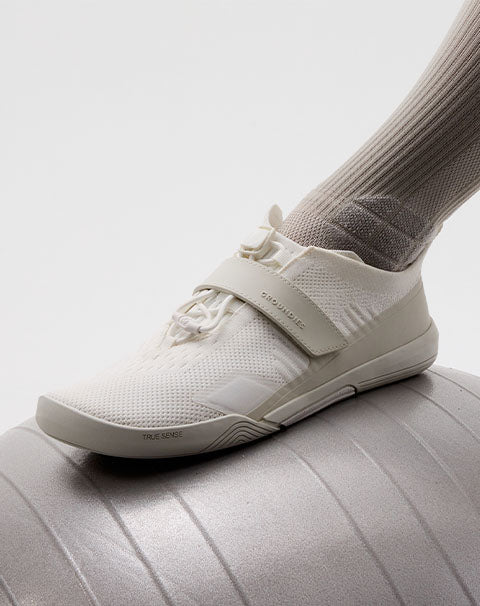
Groundies takes a different approach: we create a protected environment in which feet can perform their natural function.

Why barefoot shoes feel different at first.
First impressions count—and with barefoot shoes, they are often unfamiliar. Not because something is wrong, but because the conditions for movement are changing.
Barefoot shoes allow you to feel the ground more. Your feet take over tasks that were previously performed by your shoes. Muscles, tendons, and the nervous system become more active again. You can feel it. This new sensation is not a warning sign. It is adaptation. The body reacts to changed stimuli by reorganizing movement.
This is precisely why a gradual transition to barefoot shoes is advisable, to give the body time to adjust to the change in pressure. Movement is not a switch. It is a process.

Time as a decisive factor: The transition to barefoot shoes
When conditions change, the body needs time to process new stimuli and redistribute stress. This is exactly what happens when switching to barefoot shoes such as Groundies. The body works more actively. Feedback becomes more intense. Not only do muscles and tendons react—the nervous system does too.
Adaptation does not come about through radical change, but through habituation:
Short periods of wear, conscious breaks, and alternating between shoes help to build capacity. It's not about right and wrong, but about giving natural movement space and time.

Myths and misconceptions about barefoot shoes.
There are many assumptions surrounding barefoot shoes. Taking a differentiated view helps you make informed decisions.
Myth 1: More cushioning automatically means more protection
Cushioning can increase comfort. At the same time, it reduces feedback from the ground. Protection is not only provided by material. In the long term, the body's ability to perceive and process stress also plays a role. Movement is an interaction – not a cushion.
Myth 2: Support replaces strength and control
External support can provide short-term relief. However, lasting stability comes from active muscle work, coordination, and freedom of movement. Stability is not a product. It is a skill.
Myth 3: Barefoot shoes are extreme
Barefoot shoes such as Groundies are neither training equipment nor ideology. They are a type of shoe that allows natural movement—in everyday life, at your own pace, and adapted to individual needs. Barefoot shoes are not a panacea. The decisive factor is how consciously they are worn and in what context.


