



Barefoot shoes vs. regular shoes – which children's shoes do orthopedists recommend?
From first walking shoes for children to children's boots—choosing the right children's shoes is essential for healthy foot development. But which children's shoes do orthopedists recommend? Here are a few tips on what to look for when buying shoes for children.
As soon as the little ones are born, it usually doesn't take long before children take their first steps. Most babies try to take their first steps between 12 and 14 months of age. Some are already walking at 8 to 10 months. As soon as children start exploring the world on their feet, the focus shifts to healthy foot development. In order to develop healthily and strongly, children's feet need freedom of movement, contact with the ground, and lots of stimulation. Even the smallest foot muscles need to be trained and exercised so that they do not lose their functionality. It is good to walk barefoot regularly on soft, uneven ground, true to the motto "Those who learn to walk don't need shoes."
Whether barefoot shoes or regular shoes—good children's shoes are lightweight and flexible.
In the first few months of life, walking barefoot is the healthiest option for children. This changes at the latest when children discover the world outside their front door. Should children continue to walk barefoot in barefoot shoes, or should parents resort to regular shoes? And what should you look for when buying children's shoes? "Basically, you need to make sure that the shoe fits the foot well without slipping. The toe box should be wide enough to comfortably accommodate all toes, including the little toe. The big toe in particular should be able to align itself straight," says Dr. Caroline Werkmeister. The orthopedist from Hamburg is a specialist in sports medicine and functional foot therapy. A flexible sole is also ideal, as it allows the small foot to switch between flexibility and stability during the gait cycle. "However, additional padding, support, or an elaborate footbed can be safely dispensed with, as healthy children's feet can easily manage this themselves. It is much more important that the shoe is as light as possible and allows the child to perceive and experience the ground through the footwear," adds Werkmeister.

Good children's shoes – what makes them special and why they are so important
Good children's shoes are essential if parents want to set the course for healthy foot development at an early stage. This is because babies are usually born with healthy feet. Most foot deformities only develop over time – due to incorrect footwear. It is easy to force small, malleable feet into ill-fitting shoes. Little ones also tend to curl their toes when the salesperson wants to determine their shoe size with a measuring device or by pressing their fingers. Since the nerve cells in small children's feet are not yet fully developed, children do not really notice that their shoes are too tight or too small. It is important that little feet have the greatest possible freedom of movement in good children's shoes. This requires soft and sufficiently large children's shoes: "Wearing suitable footwear supports the healthy development of children's feet. Natural training of the foot muscles strengthens them, which leads to the proper formation of the foot shape and position. In addition, good children's shoes reduce the long-term risk of functional foot deformities and related injuries," says Dr. Caroline Werkmeister. Firm insoles or shoes that are too hard, on the other hand, damage children's flexible feet. Sensitive soles that stimulate the soles of the feet are better: "The foot is a sensory organ with a dense arrangement of tactile sensory cells in the sole of the foot. Stimulating the soles of the feet not only promotes the motor system but also the non-motor parts of the brain, such as spatial self-awareness—known as proprioception. There is also evidence that sensory stimulation of the soles of the feet has a positive effect on children's cognitive abilities," says the orthopedist.
Healthy children's shoes and choosing the right shoe size for children
Whether regular shoes or children's barefoot shoes – children's feet are sensitive and quickly lose their shape when they are squeezed into shoes that are too tight. When choosing the right shoe size for children, shoe size charts are generally a good guide. However, parents should bear in mind that the correlation between a child's age and the right shoe size is as individual as the child itself. Babies have different sized feet from birth, and children's shoe sizes vary with the speed of their growth. As a guide, a toddler's feet grow on average around 1.5 mm per month. This makes it all the more important to measure children's feet regularly. In our article "What is the right shoe size for my child?", you can read about how to measure your child's feet and determine the right shoe size.
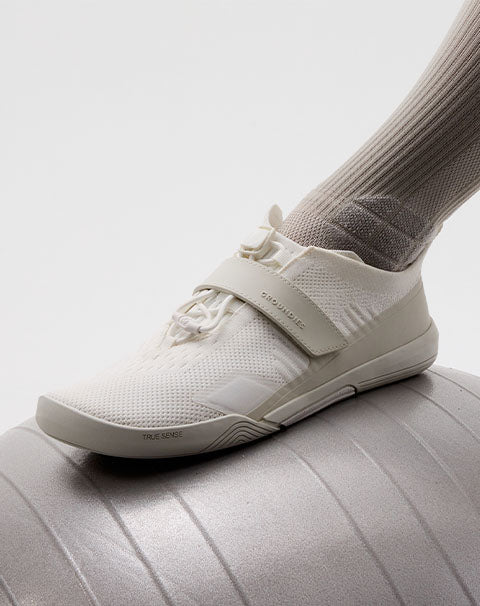
Groundies barefoot shoes for children – thin sole, flexible material, wide toe box
What benefits adults also benefits children: barefoot shoes for children have the advantage of seamlessly extending the phase of "original barefoot walking" and ensuring that the small foot muscles remain in training. This is because barefoot shoes require the foot to work harder than conventional shoes, which not only trains the foot muscles but also has a positive effect on the entire musculoskeletal system. In addition to the well-known characteristics of a thin, sensitive sole and flexible material, Groundies barefoot shoes for children also have the advantage of a wide toe box. This means that children's feet also have plenty of room in children's barefoot shoes to develop healthily.
The best children's shoes – a 5-point checklist for healthy children's feet
- flexibility
Children's shoes should be light and flexible so that children's feet can roll easily without restriction. If you bend the children's shoe upwards with your hand, there should not be too much resistance. - Firm grip
Jumping, hopping, running—a good children's shoe should offer stability as well as flexibility. The sides of the shoe should therefore provide support to protect the small ankle joint. - Right size
The right size is essential when it comes to children's shoes. Shoes that are too small can cause problems early on and lead to foot deformities later in life. As a general rule, toddlers and children who are just learning to walk should have nine to 12 mm of space in front of their big toe. This is roughly the size of a penny. - Sufficient space in the toe area
Not only the length of children's shoes, but also their width is extremely important so that the foot, and especially the toes, can move freely and unhindered. Because toddlers' feet grow an average of 1.5 mm per month, it is important that children's feet are measured regularly and correctly.
be measured. For example, with a shoe template. - Breathable materials
Children's feet sweat just as much as adults' feet, which is why even the youngest children need breathable materials in their shoes. Leather and air-permeable textiles are recommended.


